
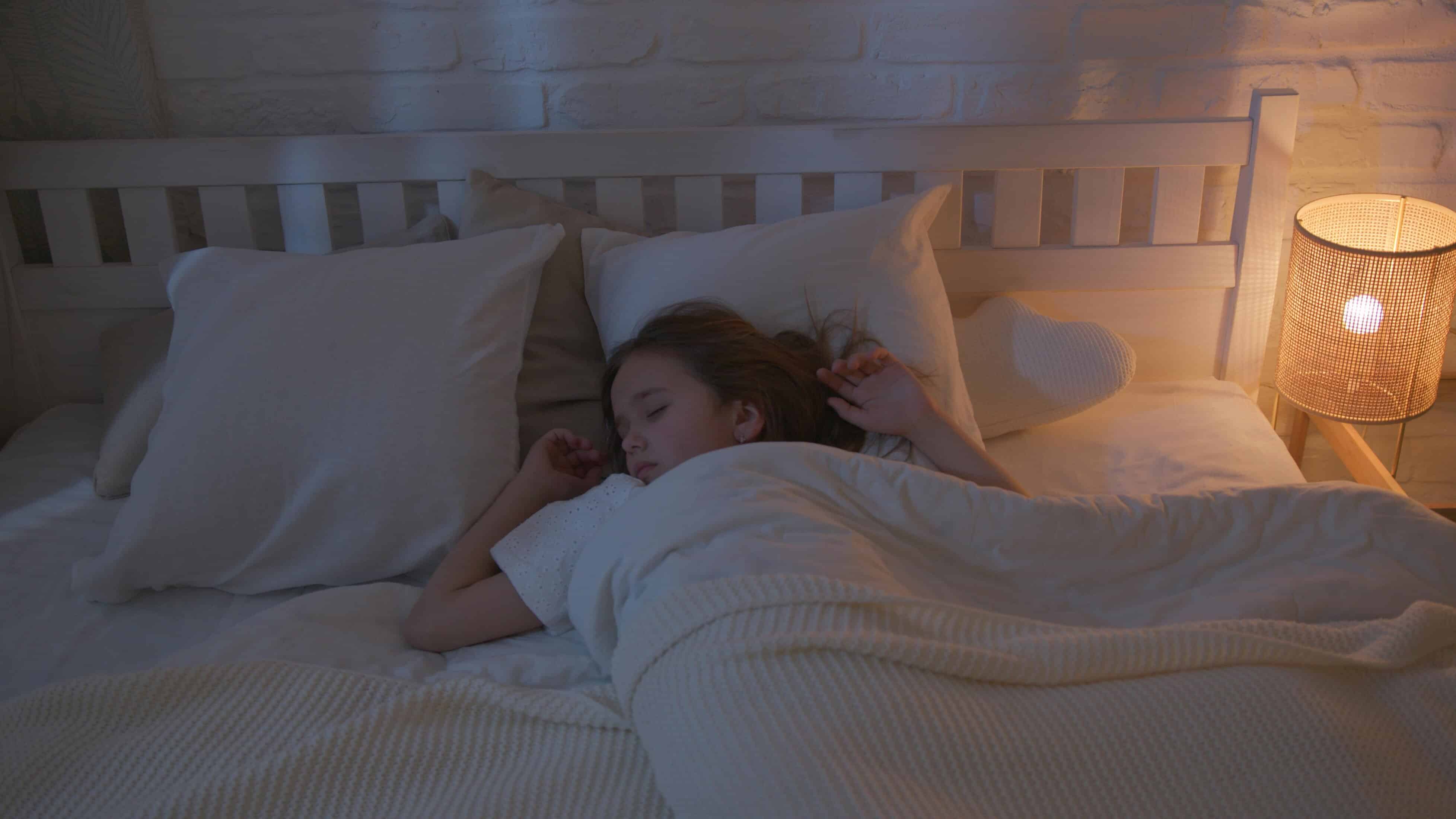
You’ve tried everything.
Earlier bedtimes. Blackout curtains. Melatonin. White noise machines. Consistent routines. You’ve read the books, followed the advice, and done everything you’ve been told should help your child sleep.
And still — your child is wide awake at 10 p.m., staring at the ceiling… exhausted, but unable to fall asleep.
If this is your reality right now, there’s something important you need to understand: you are not doing bedtime wrong. And your child is not being difficult.
What you’re seeing — that tired but wired pattern — is often a sign of nervous system dysregulation. When a child’s body is stuck in a heightened stress state (fight-or-flight), it can override even the best sleep routines, supplements, or environment.
In this post, we’re going to break down what’s really going on with your child’s sleep — and why there is real hope for deeper, more restful nights.
Did You Know? Approximately 35% of children in the United States aren’t getting enough sleep — meaning more than 1 in 3 kids are starting their day already running on empty.
Sleep Isn’t Just Rest — It’s When Your Child’s Body Does Its Most Important Work
Most parents think of sleep as simple “downtime.” But in reality, sleep is one of the most active and essential phases of your child’s entire day. While your child is asleep, their brain and body are hard at work behind the scenes.
Here’s what’s actually happening each night:
- The brain organizes and stores everything your child learned that day, strengthening neural connections and building memory
- Growth hormone surges during deep sleep — meaning your child is literally growing while they rest
- The immune system ramps up, producing infection-fighting cells (which is why kids who don’t sleep well tend to get sick more often)
- The brain processes emotions during REM sleep, so those big meltdowns and mood swings are often signs of a system that didn’t get enough reset time
- The body repairs tissues, balances hormones, and restores energy for the next day
Sleep isn’t optional — it’s foundational. When sleep is off, everything else starts to struggle… from behavior and focus to immunity and overall health.
The Real Reason Your Child Can’t Sleep: It’s the Nervous System
Here’s where most sleep advice misses the mark: it treats sleep like a behavior or routine issue… when in reality, it’s a nervous system issue.
Your child’s body is designed with two built-in systems:
- A “gas pedal” — the sympathetic nervous system — responsible for alertness, stress, and the fight-or-flight response
- A “brake pedal” — the parasympathetic nervous system — responsible for rest, recovery, and sleep
For sleep to happen, the brake has to take over. When your child’s nervous system can smoothly shift from “on” to “off,” falling asleep becomes natural and effortless.
But when there’s interference in that system — what we call subluxation — communication between the brain and body becomes disrupted. The signal to slow down doesn’t fully get through.
The result? The gas pedal stays stuck.
And now your child is in that all-too-familiar state: exhausted… but wired.
It’s like trying to fall asleep after multiple energy drinks — the body is tired, but the system won’t allow it to power down.
That’s why no amount of lavender, supplements, or perfect routines can fully solve the issue. If the nervous system can’t shift into rest mode, sleep will always be a struggle.
How “The Perfect Storm” Impacts Your Child’s Sleep From the Start
For many children who struggle with sleep, the issue didn’t begin at bedtime — it started much earlier. In fact, nervous system dysregulation often begins before a child can even talk. We call this buildup of stressors “The Perfect Storm,” and it frequently begins before birth.
During Pregnancy
Stress during pregnancy doesn’t just affect mom — it directly impacts baby. Cortisol (the body’s primary stress hormone) can cross the placenta and influence how a baby’s stress response system develops. This can predispose a child’s nervous system to stay on high alert from the very beginning.
During Birth
Certain birth interventions — such as inductions, forceps, vacuum extraction, C-sections, or manual pulling (including breech positioning) — can place stress on a newborn’s delicate nervous system. This is especially important near the upper neck, where the vagus nerve exits the skull.
The vagus nerve plays a key role in helping the body shift into rest, relaxation, and sleep. If that pathway is compromised early on, it can make it much harder for a child’s system to fully settle and regulate.
In Early Childhood
As your child grows, additional stressors can continue to build. Antibiotics may impact gut health. Ongoing challenges like reflux, constipation, or frequent illness can place repeated strain on the nervous system.
Each of these adds another layer to a system that may already be overwhelmed.
Over time, this can lead to dysfunction in the autonomic nervous system — often referred to as dysautonomia. And one of the very first signs this shows up? Sleep challenges.
For many kids, difficulty falling or staying asleep is one of the earliest indicators that something deeper is going on within the nervous system.
What Happens When Sleep Problems Go Unaddressed
Ongoing sleep struggles don’t just leave kids feeling tired — they impact nearly every aspect of a child’s growth and development.
When a child isn’t getting enough quality sleep, here’s what can happen beneath the surface:
- Behavior starts to shift. Lack of sleep can look just like ADHD — hyperactivity, impulsivity, and difficulty focusing. Because in kids, exhaustion doesn’t show up as calm and sleepy… it shows up as wired and reactive.
- The immune system can’t fully recharge. This can trap kids in a frustrating cycle: illness → antibiotics → gut disruption → increased nervous system stress → poorer sleep → more illness
- Learning becomes harder. Without proper sleep, the brain struggles to organize and retain information, making school feel more overwhelming than it should
- Emotional regulation breaks down. Those big meltdowns and mood swings aren’t simply behavior issues — they’re often signs of a nervous system running on empty
- Mental health can take a hit. Chronic sleep deprivation is closely linked to anxiety and depression, because the brain doesn’t have the capacity to process everyday stress in a healthy way
If your child is struggling with focus, behavior, immunity, digestion — or all of the above — sleep may not just be one piece of the puzzle. It may be the common thread connecting everything.
What Actually Works: Addressing the Root Cause
Neurologically-Focused Chiropractic Care takes a different approach to sleep challenges. Instead of chasing symptoms or adding more routines, it focuses on the underlying nervous system dysregulation that’s keeping your child stuck in that “tired but wired” state.
Through precise, gentle adjustments, this care works to reduce interference (subluxation) and support the nervous system’s ability to adapt and regulate. As that improves, your child’s system can finally shift more easily between stress mode and rest mode — the way it’s designed to.
When that balance is restored, the pathways responsible for rest, digestion, and recovery — including the vagus nerve — can function more efficiently. In simple terms, the body can finally slow down and settle into real, restorative sleep.
How We Measure What’s Really Going On
At 3T Family Chiropractic, we don’t guess when it comes to your child’s health.
We use INSiGHT scanning technology to objectively measure how your child’s nervous system is functioning — identifying areas of stress, imbalance, and where support is needed most. This allows us to create a care plan that’s specific, targeted, and built around your child.
One of the first changes many parents notice? Sleep.
And not long after, other improvements often follow — better digestion, fewer illnesses, calmer behavior, and greater emotional resilience. Because when the nervous system starts working better, everything connected to it improves too.
Sleep Is the Foundation for Everything
When your child is able to access deep, restorative sleep, it changes everything.
That’s when the brain can process and learn. That’s when the body can grow and heal. That’s when the immune system strengthens. That’s when emotions can be regulated more easily.
Sleep isn’t just one piece of the puzzle — it’s the foundation that supports all of it.
And if your child is struggling to sleep, it’s not simply a phase or a behavior issue. It’s often a sign of a nervous system that’s stuck — and needs the right support to reset and regulate.
There is a path forward.
If you’re ready to get to the root cause of your child’s sleep challenges, we’d love to help. Reach out to 3T Family Chiropractic today to schedule your child’s INSiGHT scans and take the first step toward better sleep for your entire family.
If you’re not local to us, you can also explore the PX Docs directory to find a neurologically-focused provider near you.